

When Could You Vote in Suffield?
One thing I will never forget was the first time I cast a ballot. It was May of my senior year of high school at my town’s annual town meeting. That night we were deciding whether to build a new high school. As someone who had experienced the inadequacies of the then high school, I was more than happy to vote yes. As I put my ballot in the ballot box, I felt a sense of pride and belonging because I had contributed to an important decision in my community.
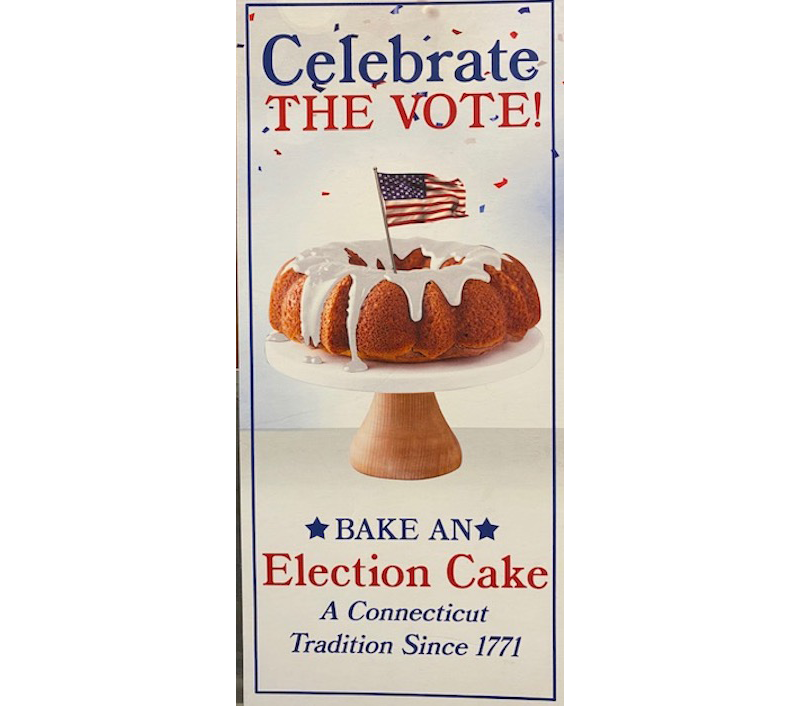
A graphic showing a Connecticut Election Cake, a dessert traditionally served on Election Day. Credit Grating the Nutmeg
Unfortunately, throughout history, voting rights have been restricted to certain groups of people. In this blog, I want to go through Suffield’s history and explore when certain groups of people were allowed to vote and why. If you were able to take a time machine back into the past, at what point would you have been able to vote?
1670
For the first 10 years of Suffield’s existence, all decisions were made by a committee of 5 men from Springfield that were responsible for organizing the English settlement effort. This group was led by John Pynchon, the son of the founder of Springfield, and included his brother-in-law Elizur Holyoke, former Springfield Selectman Benjamin Cooley, quartermaster of the Hampshire County militia, former Springfield Selectman and deputy to the Massachusetts General Court George Colton, builder of Springfield’s first meetinghouse, Lieutenant in Hampshire militia and former Windsor resident Thomas Cooper, and finally former Springfield Selectman Rowland Thomas. These men made all the decisions for the community during these early days so nobody living today would be able to vote.
1681
At Suffield’s incorporation, a committee composed of leaders from the mother town of Springfield ran the town. By 1681, John Pynchon, the leader of Springfield and head of the committee that founded Suffield decided Suffield was ready to govern itself. However, to ensure that Puritan order would be maintained, the franchise was extremely limited.
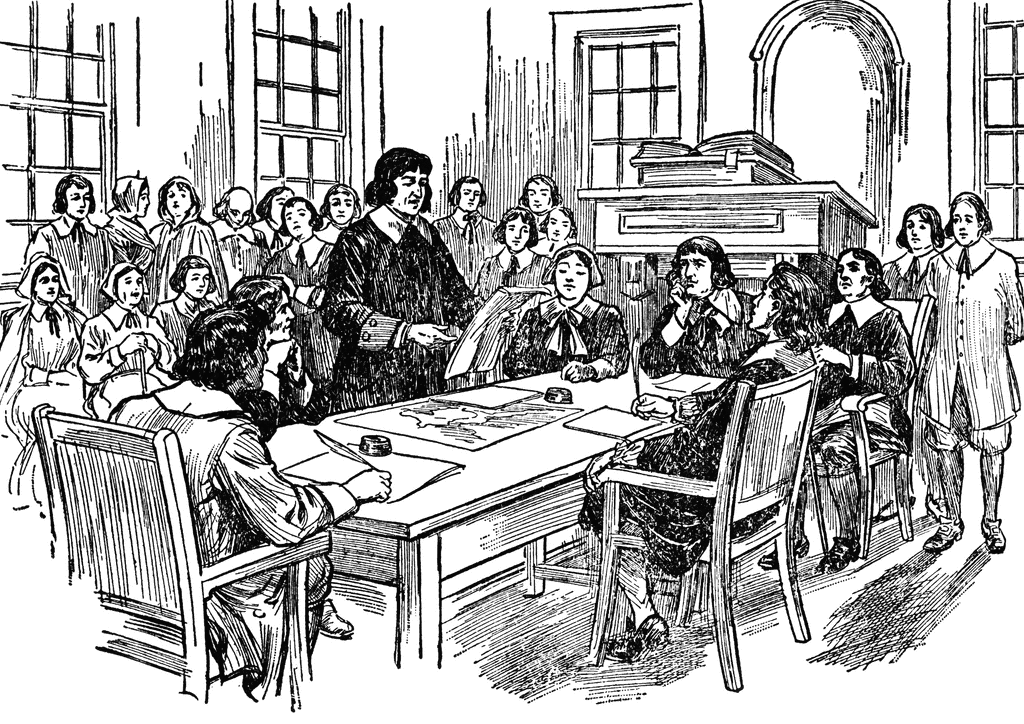
An image recreating an early New England town meeting. Credit Weber University
To qualify to vote, you needed to meet five criteria. First you needed to either be an original proprietor of the town (one of the landowners at the time of town’s incorporation) or one of their descendants. Next you needed to be a man since it was the mistaken belief at the time that women were the inferior sex and therefore, should not be allowed to vote. Additionally, you had to be over 21 years of age which was a standard inherited from English common law since it was believed that was the age that an individual could function as an adult in an agrarian society. Next, you needed to be white because it was incorrectly believed that nonwhites were unable to make responsible voting decisions. Finally, you needed to be a member of the Puritan church. So if you aren’t a male over the age of 21 descended from an original proprietor, and you are not a member of the Puritan (today’s Congregational) church, no vote for you.
Now this arrangement was not without controversy. As early as 1686 there was a formal protest of sorts. Samuel Kent and Peter Roe hijacked a town meeting to protest the fact that only about 20% of the population could vote. During the meeting Roe forced the elected moderator from his seat and began to run the meeting. Unfortunately for Roe and Kent, they were arrested, convicted of rebellion and fined £5 each. The same court ruled that the results of the hijacked meeting were null and void and Suffield had to revote.
1715
This unjust system could not last forever though. The beginning of the end came in 1712 when the proprietors voted to give themselves exclusive control over future land grants. The next year, they issued land grants which heavily favored their group, and this blatant corruption caused an uproar that resulted in a case before the Hampshire County court. In January of 1715, the court nullified the land grants and ruled that all men over the age of 21 who were members of the Puritan church, were white, and owned property were eligible to vote.
1749
After a long and drawn out process, Suffield left Massachusetts and became part of Connecticut. One of the chief reasons for joining Connecticut was its relatively liberal political system for the time. Unlike Massachusetts which had a governor appointed by the King back in England, voters in Connecticut elected their own chief executive. Additionally, Connecticut lacked the racial restrictions on voting that Massachusetts had so if a man was over 21, owned property, and was a member of the Puritan church, he could vote.
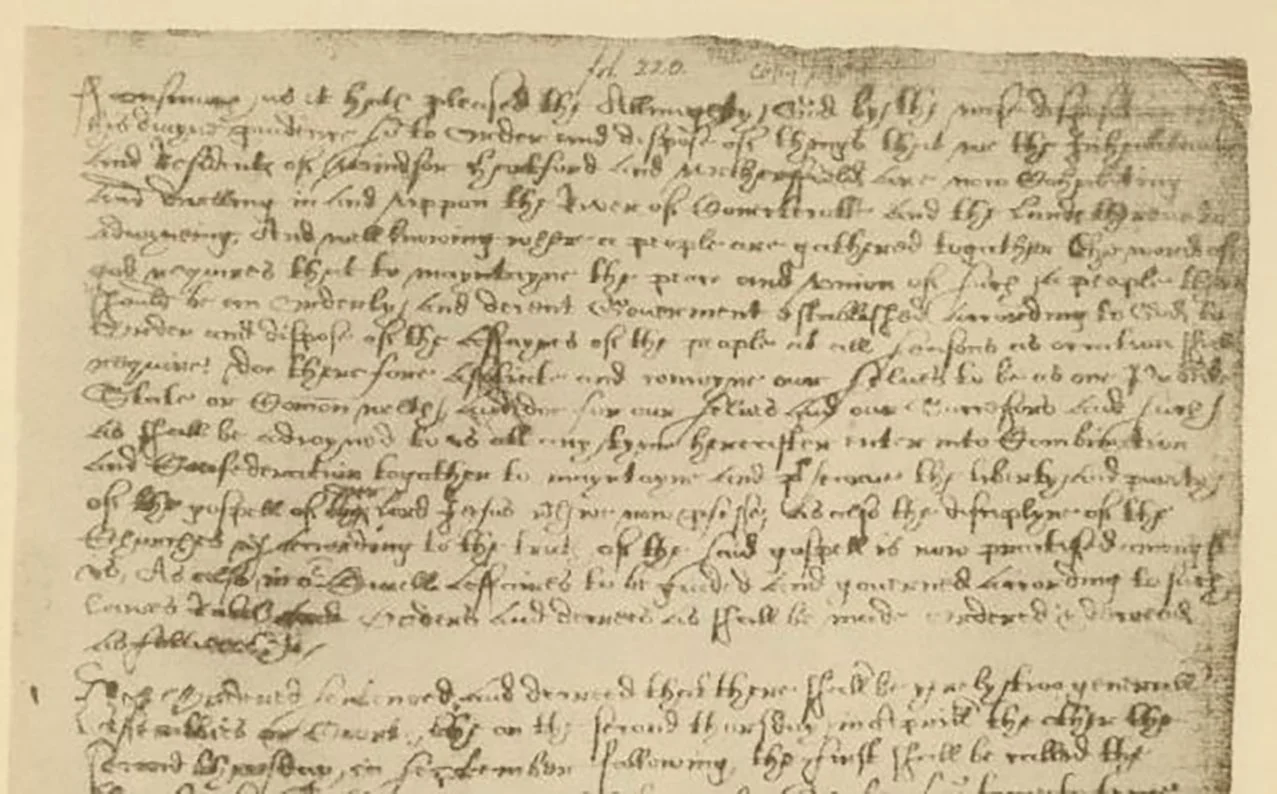
The Fundamental Orders of Connecticut which were the original colonial constitution. Credit Connecticuthistory.org
1814
Unfortunately, race would once again factor into the ability of someone to vote starting in 1814. In that year, the General Assembly passed legislation barring black citizens from voting. Connecticut and its neighbors had either outlawed slavery or were moving in that direction. This led to a substantial increase in the free black population in the state and as they bought land, they became eligible in greater numbers to vote. This triggered the racist fear of the white establishment and led them to pass this legislation to retain control over this newly freed population.
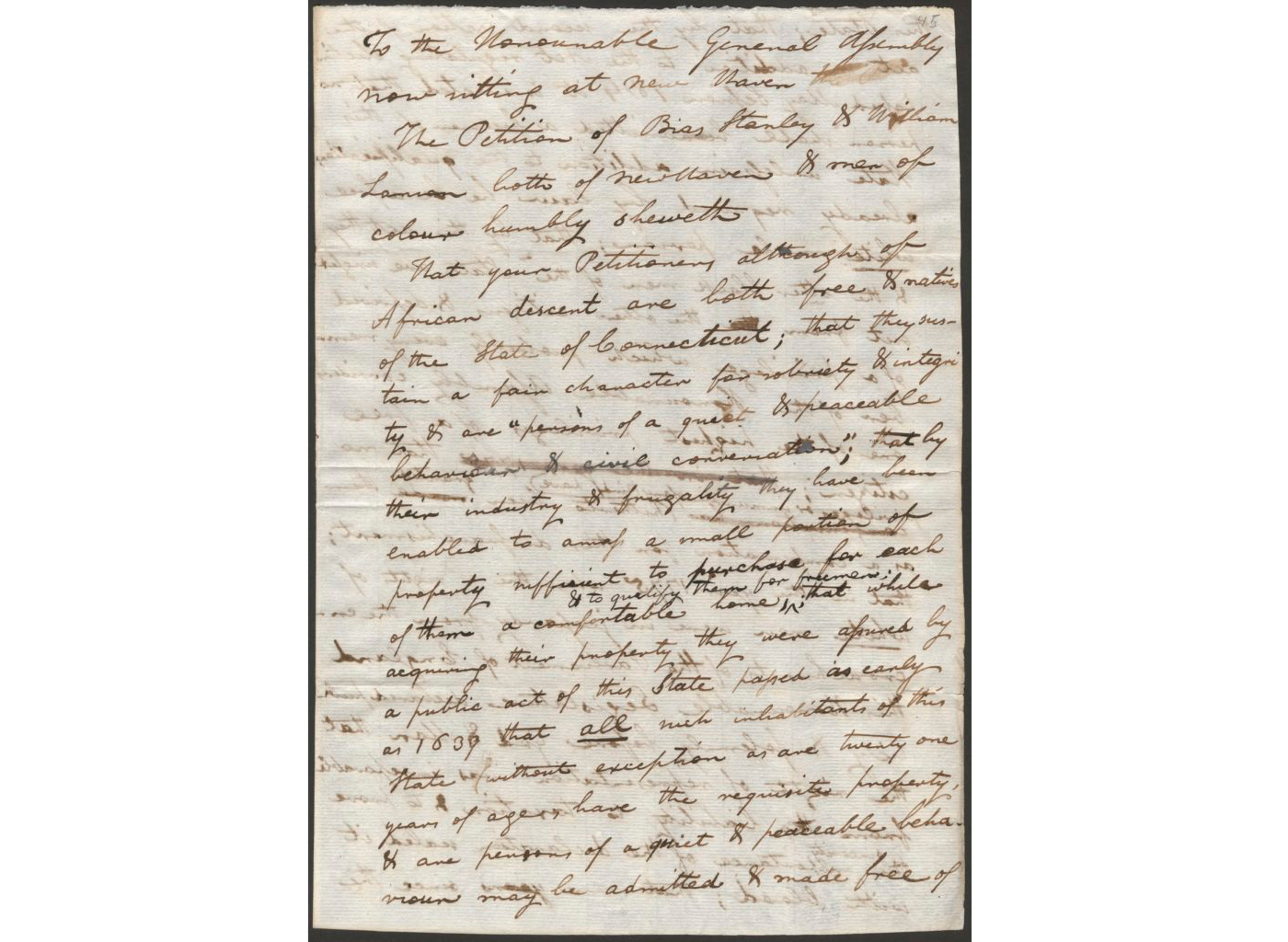
A petition to the General Assembly advocating for the restoration of black voting rights from October 1815. Credit Connecticut Explored.
Not everyone in the state was in favor of this change and petitions flooded the General Assembly. Unfortunately, those petitions fell on deaf ears and in 1814 only non-black or non-indigenous men over the age of 21 who owned property and worshiped in the Congregational Church were permitted to vote. However, the next four years would prove to be the death blow to the Standing Order (the members of the Federalist Party and Congregational Church that formed a near aristocracy in Connecticut) and lead to a massive expansion of voting rights.
1818
Over the previous two decades, a storm had been brewing in Connecticut and the originator of this storm was none other than the writer of the Declaration of Independence himself, Thomas Jefferson. President Jefferson promoted a form of democracy that rebelled against elites, like the Standing Order, and championed the idea of individual rights and liberties, including expanded suffrage. Jefferson and his ideas were popular in Suffield in no small part due to his appointment of native son Gideon Granger as postmaster general in 1801.
As the ideas of anti-elitism and increased individual rights gained steam, the Standing Order took steps to maintain their dominance by taking away the right to a secret ballot and funneling money to the Episcopal Church to keep their parishioners on the sidelines. However, the Standing Order’s announcement of their support for succession unless prosecution of the War of 1812 was terminated came out right as the news of General Andrew Jackson’s victory at New Orleans reached Hartford, led to a collapse of their legitimacy and led the way for the election of a coalition called the Toleration Party in 1817.
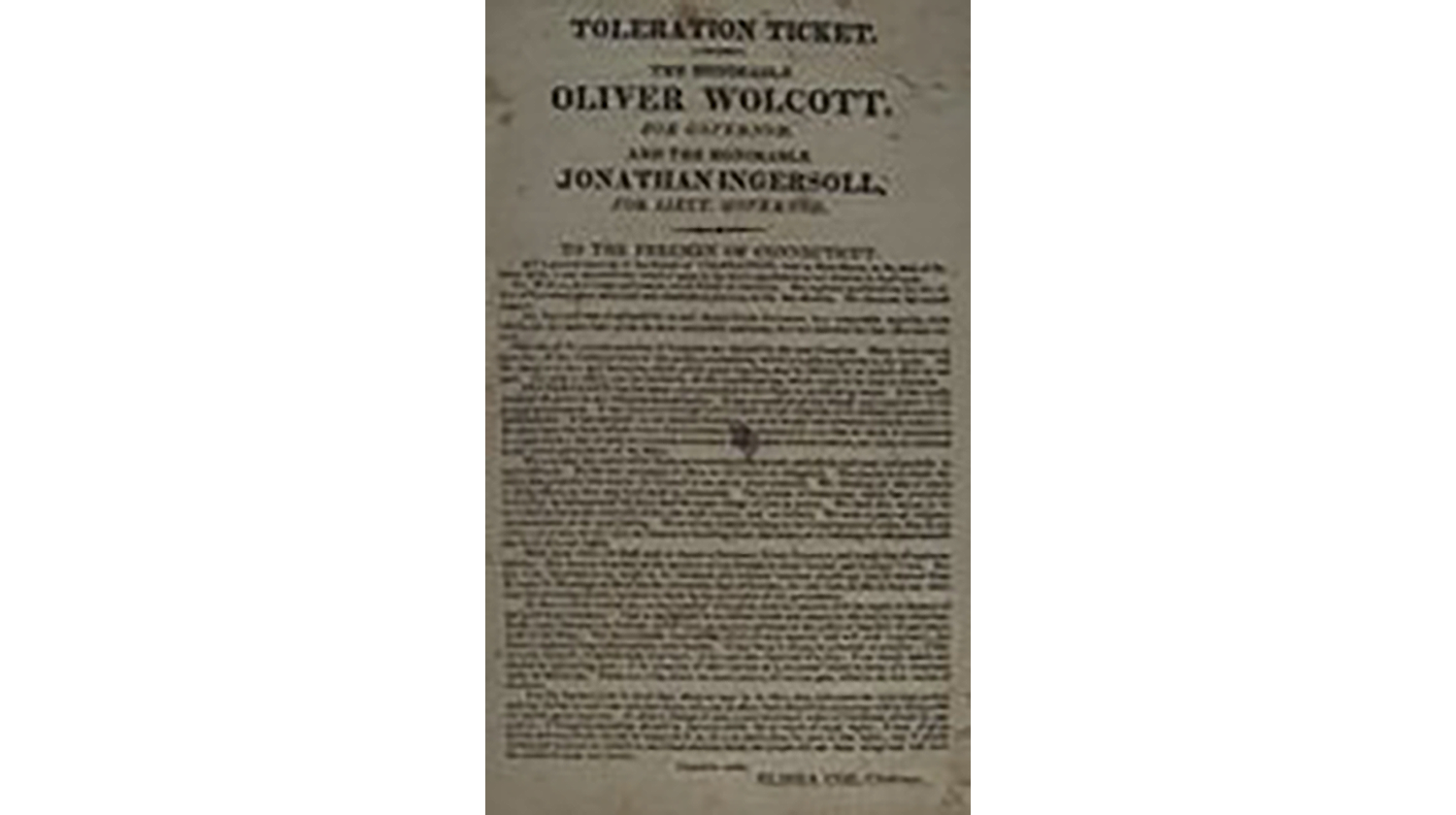
A pamphlet for the Toleration Ticket. Credit Connecticut State Library.
The Toleration Party, including Suffield’s representative to the General Assembly Martin Sheldon, voted to adopt a new Constitution which greatly expanded voting rights, with one unfortunate exception. All white men over the age of 21 were now able to vote regardless of their religion or if they had property. While this was no doubt a major expansion of voting rights, the Connecticut Constitution of 1818 has a mixed legacy due to its racial restrictions on the right to cast a ballot.
1870
1870 marked the beginning of the path toward universal suffrage. It was in that year that the 15th Amendment to the Constitution was ratified which says:
Section 1. The right of citizens of the United States to vote shall not be denied or abridged by the United States or by any State on account of race, color, or previous condition of servitude.
Section 2. The Congress shall have power to enforce this article by appropriate legislation.
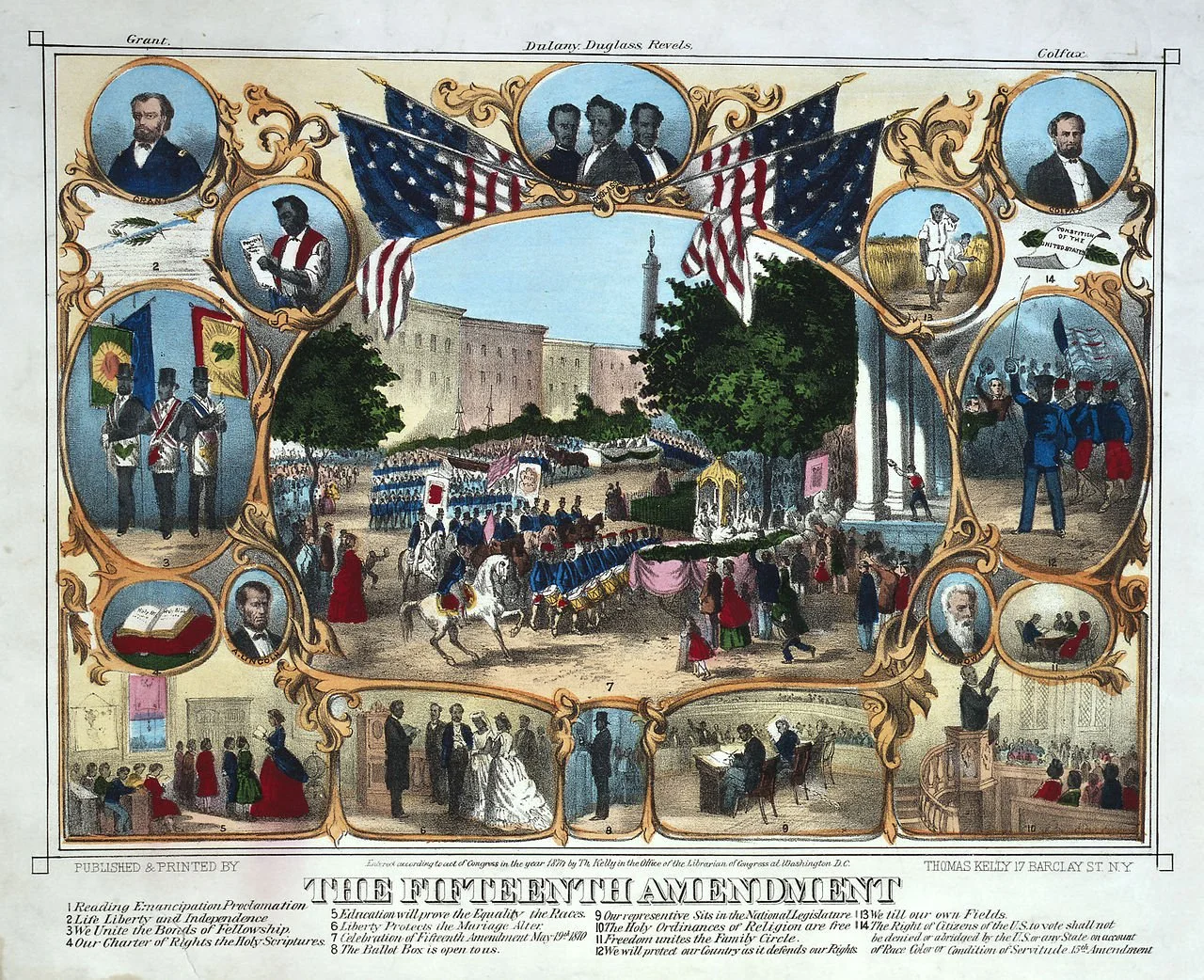
A lithograph celebrating the passage of the 15th Amendment. Credit Library of Congress
The General Assembly voted to ratify the amendment on May 19. 1869 with Suffield representative Benjamin F Hastings voting in the affirmative. Those in favor of the amendment argued that many black men had served bravely in the Civil War and to continue to deny them the vote was a travesty. By ratifying this amendment, Connecticut had begun to redress the injustices of the 1818 Constitution. However, the fight for universal suffrage was far from over with voting being restricted to men over the age of 21 who were not Native American.
1920
The year 1920 marked another great leap forward for voting rights with the passage of the 19th Amendment to the US Constitution which prohibited voting discrimination based on sex. In Suffield, the charge for votes for women was led by the Women’s Reading Club and the Ladies Wide Awake Club. These groups and others like them pushed the state to ratify the amendment on September 21, 1920.
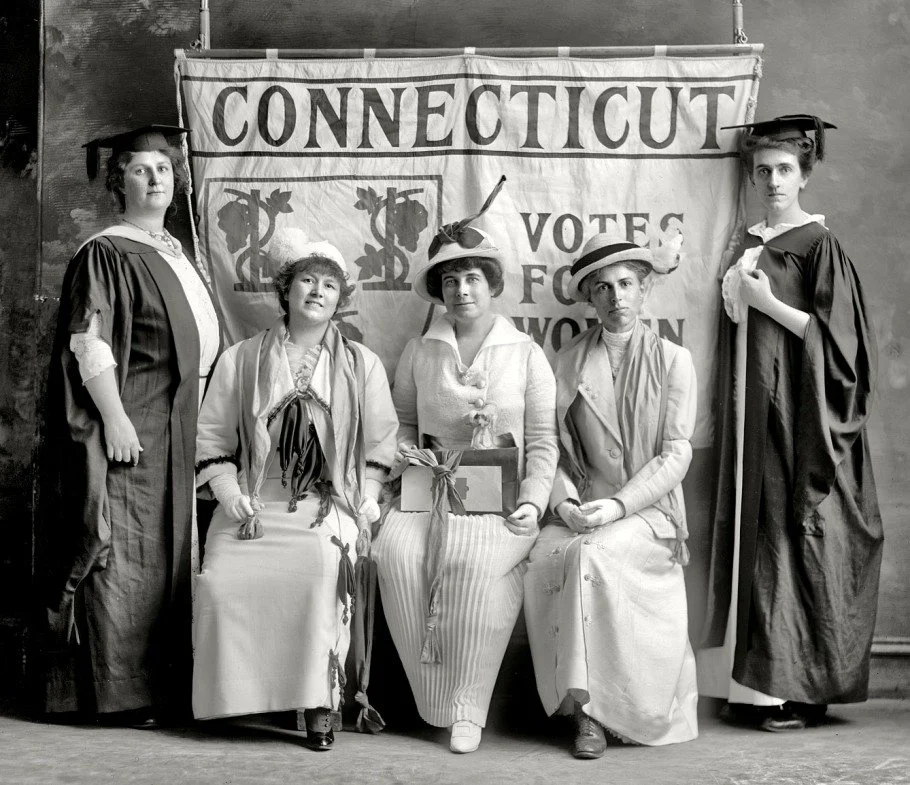
Members of the Connecticut Women’s Suffrage Association. Credit Connecticuthistory.org
Interestingly, what was supposed to be a symbolic gesture may have been quite significant in retrospect. At the time, the amendment was considered by some to be in force after Tennessee had voted for ratification the month before. The potential backlash from women’s voters was a likely reason the previously anti-suffragette Connecticut Governor Malcolm Holcomb finally called a special session to ratify the amendment. However, there was some debate on whether Tennessee had actually voted for ratification due to some discrepancies in their voting procedure. Therefore, while technically Connecticut was not the clinching vote, the state voting for ratification shut the door on any court challenges and ensured ratification was preserved.
As of 1920, men and women over the age of 21 were allowed to vote, but an exception still existed that would not be closed until 4 years later.
1924
So who still could not vote until 1924? The answer is Native Americans. The 14th Amendment to the Constitution established that all persons born in the United States were citizens except persons “not subject to the jurisdiction” of the federal government. Since some native tribes were considered sovereign entities, their members were legally not considered US citizens, but were instead considered wards of the federal government.
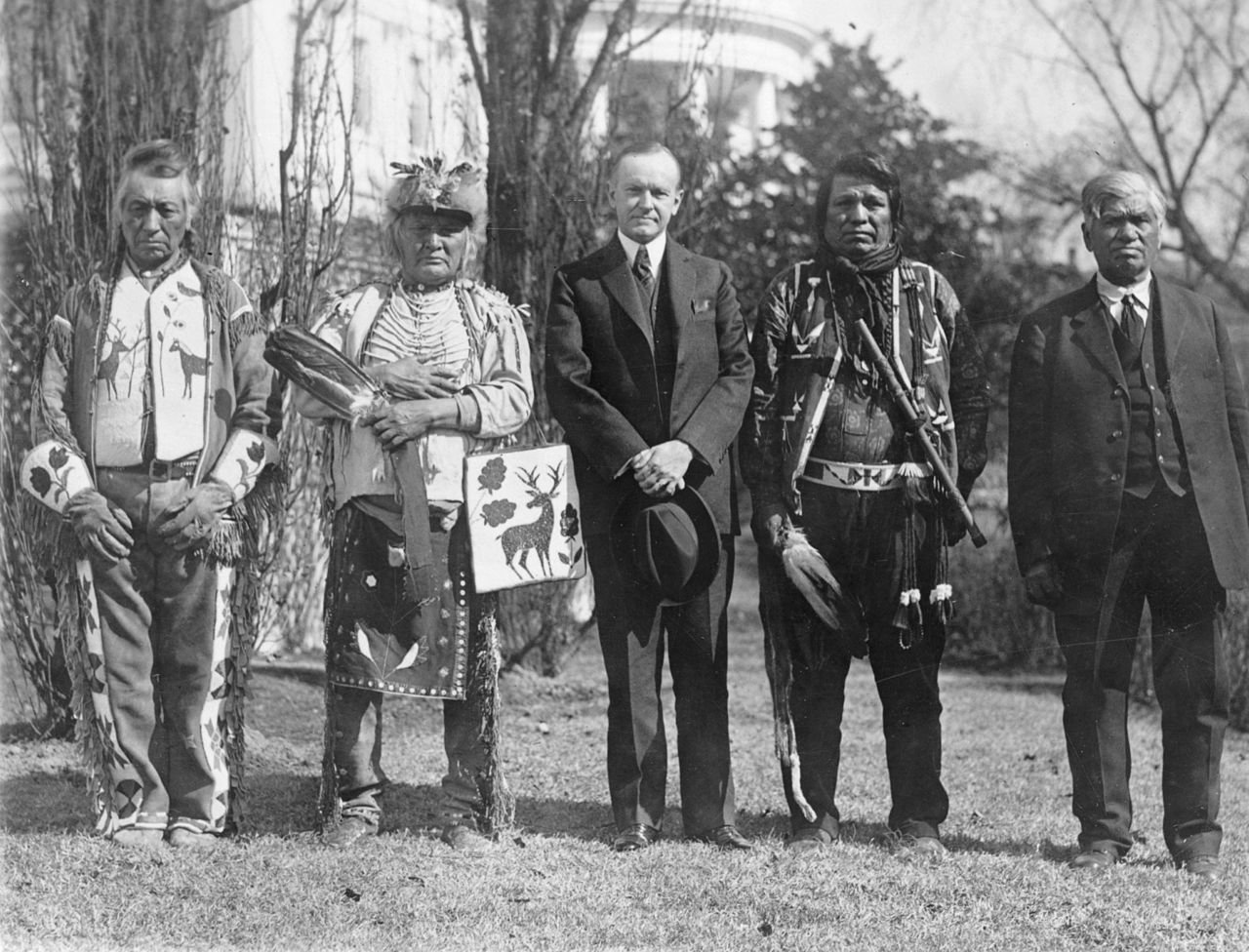
President Calvin Coolidge standing with members of the Osage Tribe during a White House ceremony for the signing of the Indian Citizenship Act. Credit Library of Congress
The views on Native American suffrage changed after World War I. Similarly to black soldiers in the Civil War, Native Americans served with distinction during WWI. This service highlighted the hypocrisy of them fighting to defend France and free Belgium from German tyranny while not being able to vote at home. The Indian Citizenship Act of 1924 closed the last de jure loophole that prevented any citizen over the age of 21 from voting.
1971
The next expansion of voting rights came came because of another war. As young people were drafted into the military to fight in Vietnam, they began to question why they were being sent to fight in a war that they had no say in. The rallying cry of “old enough to fight, old enough to vote” resonated with the people of Connecticut so much that the state voted to ratify the amendment on the same day that Congress did. It was at this point 55 years ago that any US citizen over the age of 18 was able to vote and this standard stands to this day.
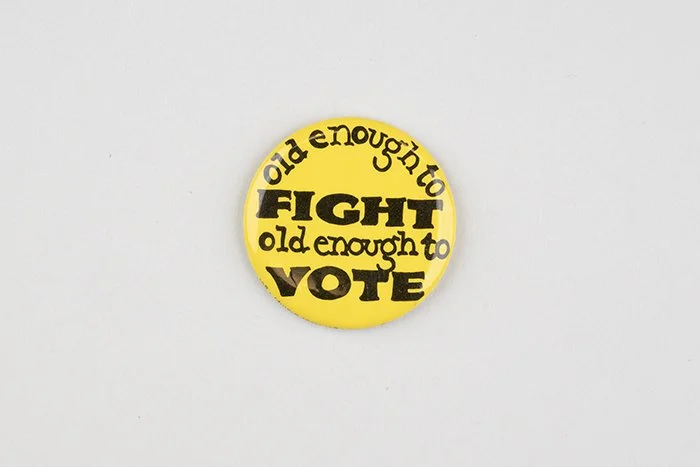
A campaign button advocating for the passage of the 26th Amendment. Credit The Museum of History and Industry.
The next time you vote either at a town meeting or on Election Day, please take a moment to remember those people that pushed for your right to have a say in how our government works. It is in that spirit that I wish you a Happy Black History Month and a Happy (Early) Women’s History Month.
Bibliography
Alcorn, Robert Hayden. A Biography of a Town: Suffield Connecticut 1670-1970. Suffield, Connecticut: 300th Anniversary Committee of the Town of Suffield, 1970.
Birnbaum, Gemma R. “‘Old Enough to Fight, Old Enough to Vote’: The WWII Roots of the 26th Amendment.” The National WWII Museum | New Orleans, October 27, 2020. https://www.nationalww2museum.org/war/articles/voting-age-26th-amendment.
Commonwealth Museum , Massachusetts Votes! § (2023). https://www.sec.state.ma.us/divisions/commonwealth-museum/download/Elections-in-MA.pdf.
Donovan, Alex. “"’No Taxation without Representation’: Black Voting in Connecticut - Connecticut History: A CThumanities Project.” Connecticut History | a CTHumanities Project - Stories about the people, traditions, innovations, and events that make up Connecticut’s rich history., October 17, 2024. https://connecticuthistory.org/no-taxation-without-representation-black-voting-in-connecticut/.
Foley, Kathy. “September 14: Connecticut Ratifies the 19th Amendment, One State Too Late. Or Was It?” Today in Connecticut History, July 30, 2025. https://todayincthistory.com/2025/09/14/september-14-connecticut-ratifies-the-19th-amendment-one-state-too-late-or-was-it/.
Staff, NCC. “On This Day in 1924: All Indians Made United States Citizens.” Constitution Daily, June 1, 2015. https://web.archive.org/web/20150602145459/http://blog.constitutioncenter.org/2015/06/on-this-day-in-1924-all-indians-made-united-states-citizens/.
Woodward, Walter, host. “Trouble in the Land of Steady Habits” Grating the Nutmeg. https://gratingthenutmeg.libsyn.com/2018/03
